Short answer: Choose 6061 when you need a versatile, corrosion-resistant, weldable and cost-effective aluminum for general mechanical parts. Choose 7075 when higher strength-to-weight performance or resistance to permanent deformation justifies higher material cost and more careful corrosion and finishing decisions. Their elastic stiffness is similar, so confirm the exact temper, product form and governing material specification before comparing properties.
Introduction
6061 and 7075 are two of the most frequently requested aluminum alloys for custom CNC machined parts. Both are heat-treatable, lightweight and capable of producing precise components. Yet they are not interchangeable.
The purchasing shortcut—“7075 is stronger, so it is better”—can increase cost without improving the product. The opposite shortcut—“6061 is easier and cheaper”—can leave a high-load bracket, hydraulic component or aerospace-style structure with insufficient strength margin. The correct choice depends on load, environment, joining method, geometry, finish, inspection and commercial priorities.
This guide compares the alloys from a buyer’s and manufacturing perspective. It also explains what information to place in an RFQ so the quoted material matches the engineering requirement.
Before comparing quotes, review the supplier’s custom CNC machining capabilities and use a structured set of CNC machining buyer resources to define material, quantity, finish and inspection requirements consistently.
Engineering note: Properties vary by temper, thickness, product form, material direction and specification. Typical values are useful for screening, but the design should use the governing material standard and supplier certificate for the actual stock.
6061 vs 7075 at a Glance
Decision factor | 6061-T6/T651 | 7075-T6/T651 | Practical takeaway |
|---|---|---|---|
Strength | Moderate to high for a general-purpose aluminum | Very high among common wrought aluminum alloys | 7075 for highly loaded lightweight parts |
Machinability | Suitable for CNC work and widely understood | Suitable for CNC work, but ratings and behavior depend on stock condition and temper | Both require a process matched to the actual stock and geometry |
Corrosion resistance | Generally better | Lower, especially in demanding environments | 6061 is more forgiving outdoors or near moisture |
Weldability | Generally good with an appropriate procedure | Usually poor for conventional fusion welding | Prefer 6061 for welded assemblies |
Anodizing | Common and generally predictable | Possible, but color and corrosion strategy need care | Validate appearance on production stock |
Raw material cost | Usually lower | Usually higher | Use 7075 only where its properties create value |
Typical applications | Housings, fixtures, frames, manifolds, automation parts | High-load brackets, UAV parts, structural and precision components | Match the alloy to load and environment |
The Aluminum Association describes 6xxx alloys as versatile, heat-treatable, formable and weldable with moderately high strength and excellent corrosion resistance. It describes 7xxx alloys, including 7075, as very-high-strength alloys commonly associated with aircraft applications. That series-level distinction provides useful screening context, but temper, product form and the governing specification remain essential.
What Is 6061 Aluminum?
6061 is an aluminum-magnesium-silicon alloy. It is one of the most broadly available and widely used wrought aluminum grades. For CNC work, 6061-T6 and stress-relieved variants such as T651 or T6511 are common depending on product form. The “T6” condition indicates solution heat treatment and artificial aging; the additional digits identify stress relief and product-form details that must match the drawing and material certificate.
Why buyers choose 6061
Good balance of strength, weight and cost.
Strong corrosion resistance for many industrial environments.
Reliable machinability and broad stock availability.
Better conventional weldability than 7075.
Familiar anodizing, painting and conversion-coating routes.
Suitable for prototypes and repeat production across many industries.
Typical CNC applications include equipment housings, sensor mounts, fixtures, robotic components, manifolds, electronics enclosures, optical bases, automotive prototypes and structural frames.
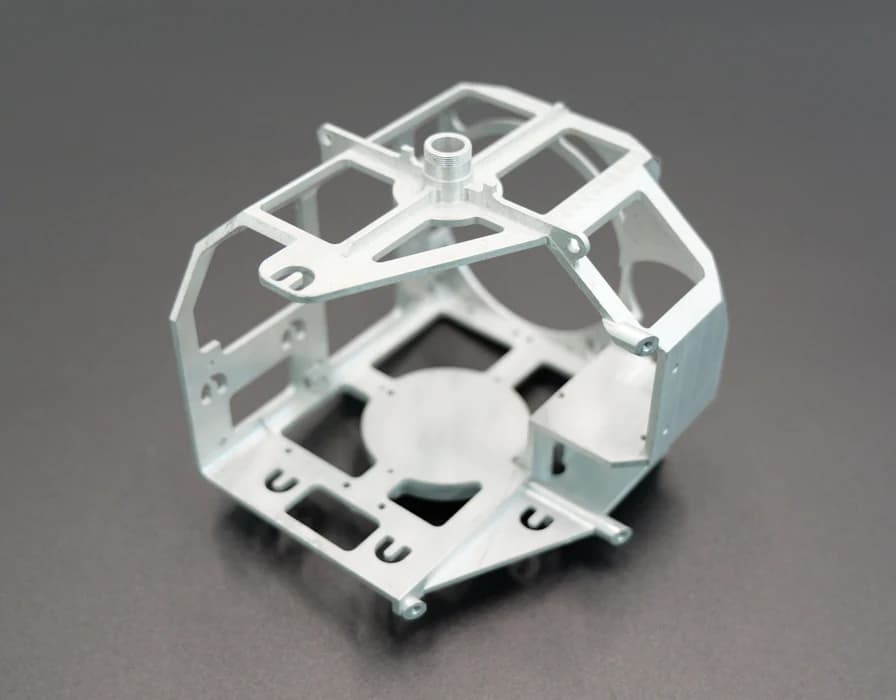
VOGUC’s existing example set includes 6061 UAV components such as a gimbal frame and an anodized quadcopter frame. These are credible examples of why 6061 is popular: complex geometry, low mass, adequate structural performance and finish compatibility can matter more than maximum tensile strength.
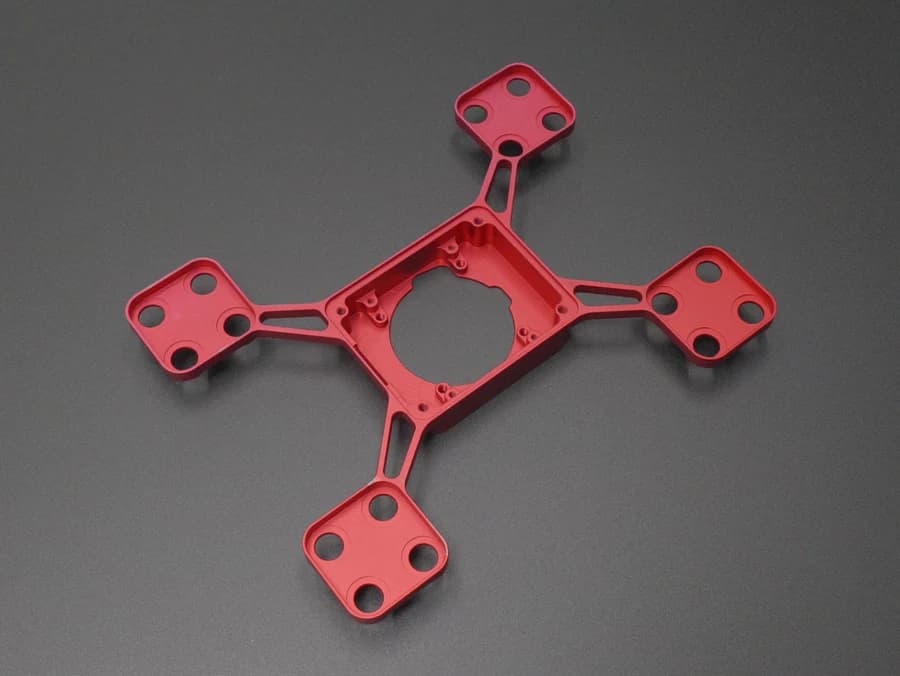
This anodized 6061 UAV frame illustrates how low mass, machined pockets and finish compatibility can be more important than selecting the highest-strength aluminum by default.
What Is 7075 Aluminum?
7075 is an aluminum-zinc-magnesium-copper alloy designed for high strength. Common machined tempers include T6/T651 and, for some product forms and service needs, over-aged conditions such as T73/T7351.
Kaiser Aluminum’s 7075 rod-and-bar data describes it as the highest-strength alloy among common screw-machine alloys and notes extensive aircraft and ordnance use. The same product-form-specific data shows an important nuance: T73/T7351 sacrifices some strength relative to T6/T651 while improving stress-corrosion resistance.
Why buyers choose 7075
High yield and tensile strength for its weight.
Machinability suitable for precision CNC work when tooling and parameters match the stock condition.
Better resistance to local deformation in highly loaded features.
Valuable for compact structures where increasing section thickness is difficult.
Established use in aircraft-style structures, UAVs, motorsport, high-performance equipment and precision mechanical systems.
VOGUC’s current case library includes a 7075 micro hydraulic valve body and a 7075 automotive oil-pump housing. These examples suit 7075’s profile: compact geometry, pressure or load considerations, and a need for stable precision features. They do not imply that 7075 is always required for hydraulic or automotive parts; the design load, fluid compatibility, corrosion protection and governing specification must decide.
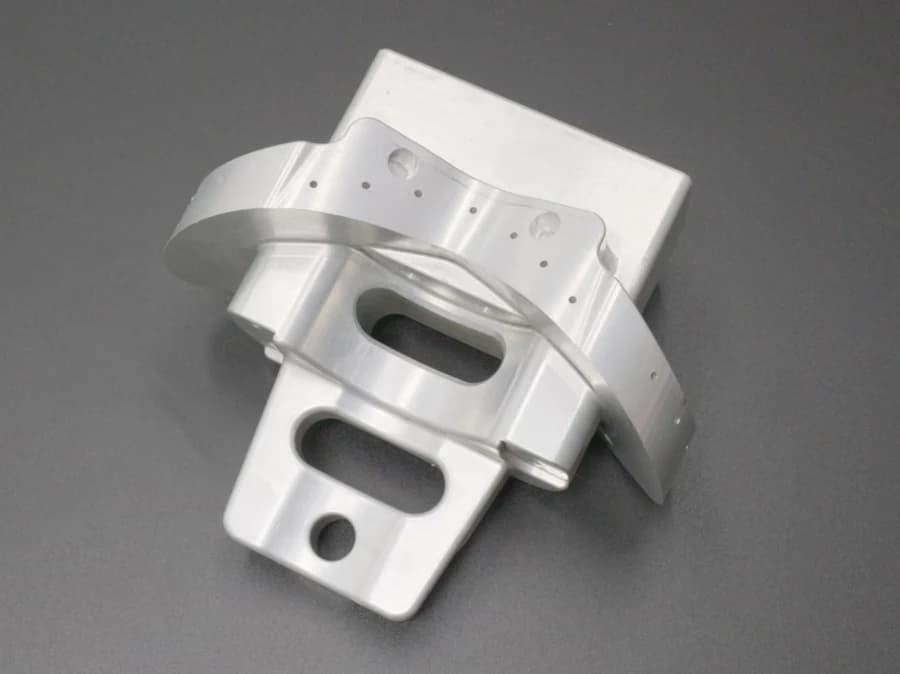
This compact 7075 valve body is an application example, not a universal material recommendation; pressure, fatigue, fluid compatibility and the governing drawing still control alloy selection.
Mechanical Properties: The Biggest Difference
For commonly compared T6/T651 conditions, 7075 has substantially higher yield and tensile strength than 6061. A representative 7075-T6/T651 rod-and-bar datasheet lists typical ultimate tensile strength around 572 MPa and yield strength around 503 MPa for its stated specimen. A 6061 value depends on product form and governing standard, but it is materially lower.
Do not combine figures from different manufacturer sheets into an unlabeled comparison table. Hydro's published 6061-T6/T6511 values are minimum properties for extrusions within stated wall-thickness ranges, while Kaiser's quoted 7075-T6/T651 figures are typical values for a 0.500-inch rod-and-bar specimen. They show the scale of the strength difference, but they are not a like-for-like design comparison. For engineering selection, compare minimum requirements and certified stock data under the same product form, temper and governing specification.
Those numbers are useful only when used correctly:
They are not guaranteed values for every thickness and product form.
Design allowables may differ from typical datasheet values.
Fatigue, notch sensitivity and load direction can govern before static tensile strength.
Machining can expose residual stress or create thin features that behave differently from bulk coupons.
Corrosion and elevated temperature can change long-term performance.
When 7075’s strength is worth paying for
7075 earns its premium when the part is strength-limited and size or mass cannot increase. Examples include a compact UAV bracket, a highly loaded lever, a thin structural web, a high-clamp-load fixture or a precision component where deformation affects alignment.
If a 6061 part already meets load, stiffness, fatigue and life requirements with comfortable margin, changing to 7075 may not create customer value. It may only raise material and documentation cost.
Strength is not stiffness
6061 and 7075 have similar elastic modulus compared with the large difference in yield strength. This means a same-shape 7075 part will not necessarily deflect dramatically less than a 6061 part while both remain elastic. To reduce elastic deflection, geometry—ribs, section thickness, load path and span—often matters more than alloy choice.
7075 helps when the design is limited by yielding, permanent deformation, local bearing stress or strength-to-weight ratio. Engineers should not use “higher strength” as a substitute for stiffness analysis.
Machinability: Which Alloy Is Easier to CNC?
Both 6061 and 7075 can produce precise machined surfaces with the right tools and parameters. Hydro’s 6061 extrusion data notes adequate machinability in T6/T6511 while warning that chips can be difficult to break in some operations. Kaiser’s 7075 rod-and-bar sheet rates T6/T651 machinability as fair. These are product-specific references, not universal rankings; the program must reflect the actual temper, stock form and geometry.
Practical machining differences
Cutting force and tool wear: 7075’s higher strength can increase cutting load, while well-selected tooling still produces clean chips. Tool geometry, coating, spindle power and coolant strategy matter.
Thin-wall distortion: Either alloy can move as material is removed. Stress-relieved plate, balanced roughing, rest periods and symmetric stock removal may be needed for frames and large pockets.
Burr formation: Burr behavior depends on tool sharpness, edge geometry and cutting parameters, not just alloy name. Plan accessible deburring and define edge conditions.
Dimensional stability: Do not assume that the stronger alloy automatically holds a tighter tolerance. Stock stress, feature geometry, setup design and thermal control dominate many precision outcomes.
Surface appearance: A fine machined finish is feasible in both. Cosmetic faces should be identified so toolpaths and handling can be planned accordingly.
For a quote, send the complete geometry. A material comparison made without wall thickness, pocket depth and tolerance information is incomplete. The relevant CNC milling capability should be assessed against the part’s actual envelope, setups, tool access and critical features—not the alloy name alone.
Corrosion Resistance and Service Environment
6061 generally offers better corrosion resistance than 7075. The copper-containing, high-strength 7xxx family can be more vulnerable in aggressive conditions, and stress-corrosion behavior depends strongly on temper and material direction.
For indoor automation equipment, the difference may be manageable with the selected finish and maintenance conditions. For marine exposure, salt spray, trapped moisture or corrosive fluids, the design requires more careful material and protection review.
Ask these questions:
Will the part contact salt, coolant, cleaning chemicals or process fluids?
Are dissimilar metals present, creating galvanic-corrosion risk?
Can water collect in pockets or crevices?
Will anodizing or conversion coating remain intact on all functional surfaces?
Is T6 strength essential, or would another temper improve environmental resistance?
Does the customer specification restrict alloy, temper or finish?
The answer may still be 7075, but it should be a deliberate system decision rather than a strength-only choice.
Welding and Joining
6061 is commonly welded with an appropriate process, filler and post-weld design allowance. Welding changes properties in the heat-affected zone, so the assembly must be designed for the as-welded condition or reprocessed as required.
7075 is generally not selected for conventional fusion-welded structures because of crack sensitivity and property concerns. Mechanical fastening, bonding or a design that uses a weldable alloy in the welded region is usually more practical.
For either alloy, tell the CNC supplier whether the part will be welded, bonded, press-fit, riveted or bolted after delivery. Machining datums and allowances may need to reflect the downstream joining process.
Anodizing and Other Surface Finishes
Both alloys can be anodized, but they may not produce the same color or corrosion behavior. Alloying elements, temper, surface preparation, batch chemistry and part geometry affect appearance. Clear anodizing is especially sensitive because the substrate influences tone.
For functional anodizing
Define:
Anodizing type or governing specification.
Target thickness range if functionally necessary.
Masked threads, bores, grounding faces and press fits.
Final dimensional requirements after coating.
Sealing or corrosion-performance requirement.
For cosmetic anodizing
Add an approved color range, reference sample, viewing condition and acceptance rule. “Black anodized” is not a complete cosmetic specification. Mixed-alloy assemblies or parts cut from different stock lots may show color variation.
Hard anodizing can improve surface hardness and wear behavior, but it does not turn aluminum into a universally wear-proof material. Contact pressure, counterface, lubrication and edge geometry still matter.
Cost and Supply Considerations
7075 stock usually costs more than 6061, and the gap can grow when certification, a special temper, a large block or a traceable mill source is required. Total part cost also includes:
Buy-to-fly ratio: how much stock is removed.
Stock form and minimum purchasing quantity.
Cycle time and tool consumption.
Stress-relief and intermediate inspection needs.
Finishing and masking.
Material certificates and traceability.
Yield loss from cosmetic or dimensional rejection.
A small high-value bracket may have only a modest absolute price difference. A large housing machined from thick plate may carry a substantial material premium. Ask for an alternate-material quote only if engineering can approve the substitution.
Material-selection checkpoint: If the alloy is still open, submit the same drawing, quantity, finish and inspection scope for both approved options. This keeps the comparison focused on stock availability, machining risk and total delivered cost. Send the drawing for a two-option review.
Application-Based Selection Guide
Choose 6061 when the project prioritizes
General industrial strength with lower material cost.
Corrosion resistance in typical service environments.
Welded construction.
Predictable prototyping and broad stock availability.
Cosmetic or functional anodizing with established expectations.
Housings, fixtures, frames, manifolds, mounts and automation components.
Choose 7075 when the project prioritizes
High strength-to-weight performance.
Compact load-bearing geometry.
Resistance to permanent deformation at a given section size.
Aircraft-style brackets, UAV structures, high-performance mechanisms or demanding precision components.
A design already validated for 7075’s corrosion, joining and finish constraints.
Do not choose either alloy by label alone when
The component is pressure-retaining under a regulated code.
Fatigue life or fracture toughness governs.
Saltwater or aggressive chemical exposure is severe.
Elevated-temperature strength is critical.
Electrical or thermal conductivity is the primary requirement.
The drawing or customer specification mandates another grade.
A Realistic DFM Review: Two Lightweight Part Scenarios
Scenario A: anodized UAV gimbal frame
The frame has multiple pockets, thin ribs, threaded holes and several alignment surfaces. Loads are moderate, mass matters and the part needs a consistent black finish. 6061-T6/T651 is a strong starting point because it machines predictably, supports anodizing and provides adequate performance for many such designs.
The DFM review should focus on rib thickness, internal radii, datum transfer, distortion after roughing, masked threads and final alignment inspection. If analysis shows yielding at a critical load case, 7075 may become relevant—but geometry optimization should be evaluated at the same time.
Scenario B: compact hydraulic valve body
The body contains intersecting passages, sealing faces, precision bores and limited wall thickness. A high-strength 7075 condition may support compact geometry, but the project team must also review pressure, fatigue, fluid compatibility, plugging method, corrosion protection and proof testing.
Inspection should cover bore size and location, sealing-surface condition, passage connectivity and cleanliness. Shipment inspection should confirm plugs, protective packaging and documentation. The material decision cannot be separated from the complete validation plan.
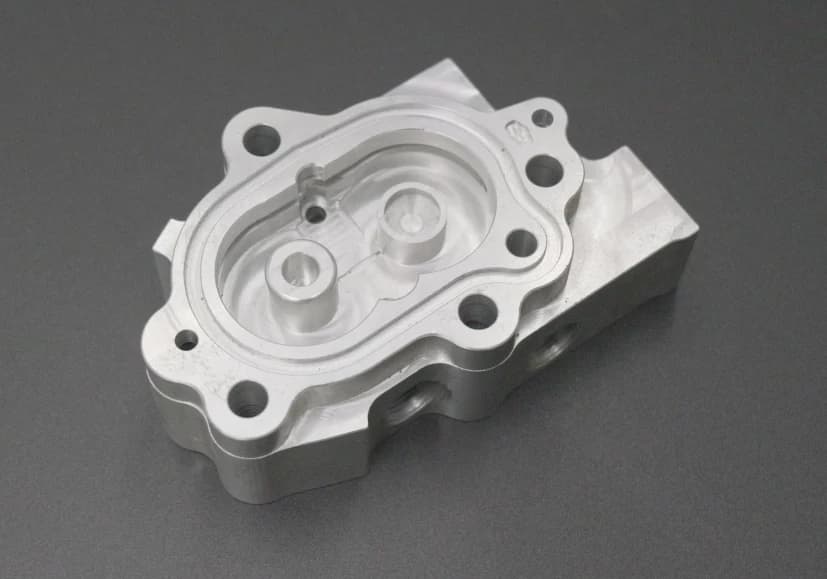
A 7075 oil-pump housing shows the type of compact precision geometry that may justify a high-strength alloy, provided loads, environment, finish and inspection requirements are validated together.
What to Put in the RFQ
For a useful 6061/7075 quote, provide:
Alloy and temper, such as 6061-T651 or 7075-T651.
Product form or governing material specification if controlled.
3D CAD model and revision-controlled 2D drawing.
Critical dimensions, GD&T and surface roughness.
Finish specification, color, masking and final-condition dimensions.
Prototype quantity and estimated production volume.
Material certificate and traceability needs.
Service environment and unusual load or chemical exposure.
Required inspections, reports or functional tests.
Delivery location, packaging and labeling requirements.
If the alloy is not yet fixed, state the functional priorities and request two options. The supplier can compare raw material availability and manufacturability, while the customer retains responsibility for final engineering approval.
Frequently Asked Questions
Is 7075 aluminum always better than 6061?
No. 7075 offers much higher strength in common tempers, but 6061 is generally more corrosion-resistant, weldable, available and economical. If 6061 meets the load and life requirements, 7075 may add cost without functional benefit.
Which alloy is better for CNC machining?
Both can be CNC machined successfully. Hydro describes 6061-T6/T6511 extrusion machinability as adequate and notes chip-control concerns; Kaiser rates 7075-T6/T651 rod-and-bar machinability as fair. Geometry, stock condition, tooling, tolerance and product form matter more than a universal alloy ranking.
Which is better for anodizing, 6061 or 7075?
Both can be anodized, but 6061 is often preferred when predictable general-purpose corrosion protection and cosmetic response matter. 7075 requires closer attention to alloy-dependent color, surface preparation and service environment. Approve cosmetic samples from production-equivalent stock.
Can 7075 be welded?
7075 is generally considered a poor choice for conventional fusion welding because of cracking and property concerns. Designers commonly use mechanical fasteners, bonding or a weldable alloy for joined structures. Confirm the joining method with a qualified engineer.
Is 7075 more expensive than 6061?
Usually yes. The final difference depends on region, product form, stock size, temper, certification and order quantity. Compare total machined-part cost, not only price per kilogram.
Can I substitute 6061 for 7075 to reduce cost?
Only after engineering review. Check yield, fatigue, bearing stress, deflection, corrosion, finish and safety margin. The CNC supplier can quote the alternative, but the design authority should approve the substitution.
Conclusion
6061 is often a practical starting point for CNC machined components that need balanced strength, corrosion resistance, weldability, finish compatibility, availability and cost. 7075 becomes the stronger candidate when high strength in a compact, lightweight part justifies its premium and its environmental and joining limitations are controlled.
The best selection process starts with function, not an alloy ranking. Confirm the temper, model the load, review the service environment, define the final finish and inspect the critical characteristics. Then ask the machining supplier to compare process risk and stock availability before the drawing is frozen.
Ask for a Material and DFM Review
Choosing between 6061 and 7075 for a custom part? Send VOGUC your CAD model, drawing, expected quantity, load priorities, finish and inspection requirements. The team can review machining and sourcing implications and prepare a quote for the approved material option.
CTA: Request a 6061 or 7075 CNC machining quote — Include the alloy/temper or ask for a two-option quotation.